
Why Use Pile Foundations in New Neighbourhoods? Building Stronger Communities
Why use pile foundation for new residential developments? In clay-rich or waterlogged areas, pile foundations can prevent structural issues from the start.
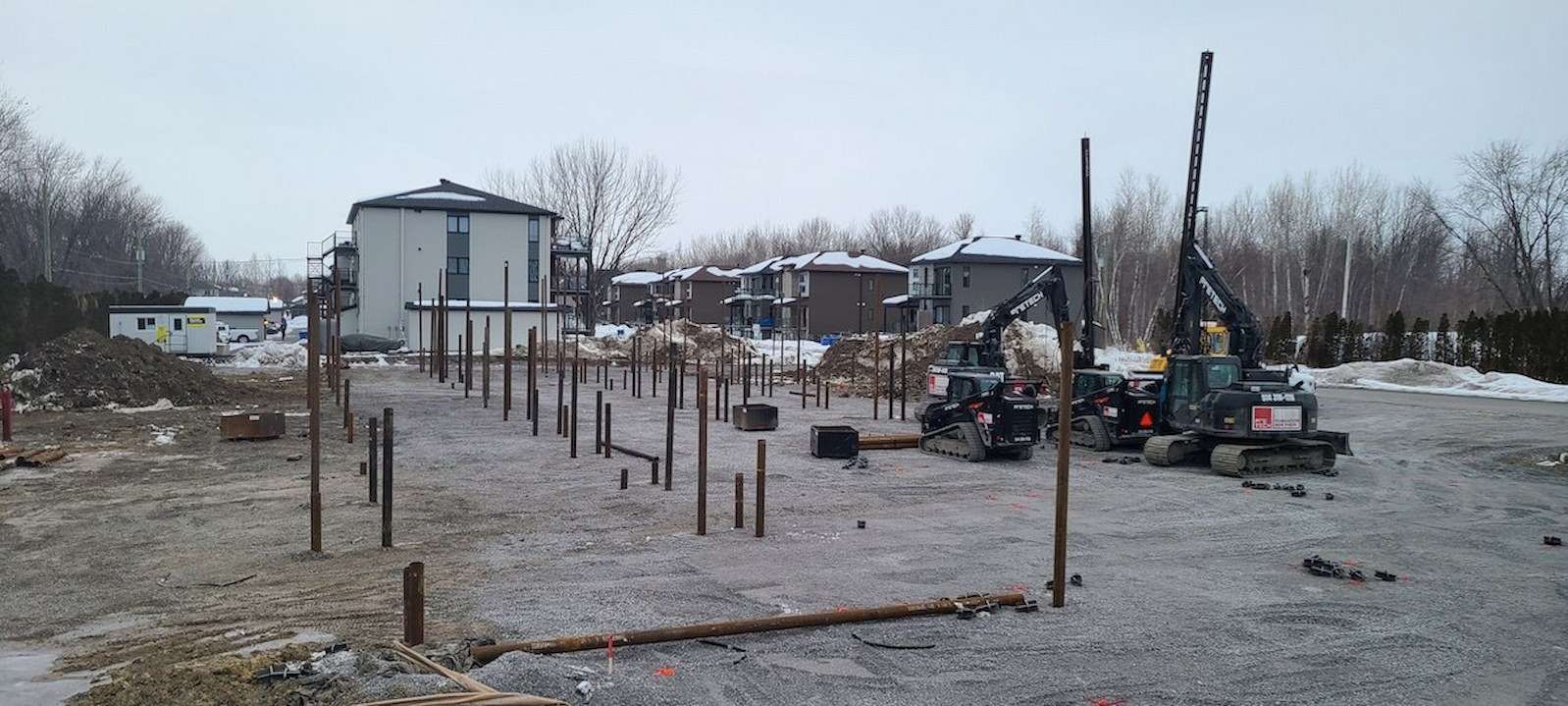
Whichever type of pile you choose for a project, it is sometimes necessary to build pile foundations for new homes, even for entire neighbourhoods. There are many types of foundations in building construction, so why use pile foundations specifically? Considering the type of soil found in many populated areas of Quebec, and the severity of sinking foundation damage, using effective solutions such as pile foundations is often the smartest way to ensure solid houses and stronger communities.
What Conditions Require Pile Foundations?
Many conditions can justify the use of a pile foundation for a house. Generally, any soil considered to be unstable can require this type of foundation.
This includes soil with high clay or silt content. These components collapse easily and cause an uplift when they freeze. Since they react to water and changing temperatures, they aren’t stable and can cause buildings to sink. Building a foundation in a waterlogged area can also require pile foundation for the same reason. Even “normal” soil, when saturated with water, will tend to be more unstable.
Sandy soil is also considered weak, as is soil containing a lot of organic matter. The latter is great if you want to create a luxurious garden but will compact easily under heavy weight.
With a pile foundation, the house rests first on the piles rather than the superficial layers of soil. When driven deep enough, the piles can reach bedrock or stable soil, providing a much more secure base. This added stability helps prevent settling and uneven movement of the structure.
When building in new areas and assessing the need for using pile foundations, it’s important to verify local building codes and the environmental impact potentially caused by noise and vibration.
What Type of Foundation Is Best For a High Water Table?
A high water table means that groundwater is close to the surface. It’s important to know that the level of ground water can fluctuate over time. In the short term, it can change between seasons, but it can also shift significantly over the long term.
In some cases, the water table is so high that it can cause direct damage to the foundation walls, either by direct pressure or by creating moisture problems like mould. Water can also saturate the soil and cause instability. Foundations could start to crack and settle, which could lead to foundation failure.
Just like for foundations in waterlogged areas, construction where the water table is high benefits from deep pile foundations. Deep piles are driven past the saturated soil, down to stable soil or bedrock. The house then rests on these piles, instead of on unstable soil, greatly reducing the risk of foundation damage. In some cases, it may also be necessary to add solutions to manage moisture levels, such as installing a French drain to help direct excess water away from the foundation.
In warmer climates, pier and beam foundations are sometimes used. In these cases, the house is elevated off the ground, allowing air and water to move freely underneath. However, this type of construction makes floor insulation more challenging, which is why it’s generally not recommended in Canada’s colder climate. That said, it can be a practical option for buildings that aren’t used year-round, such as a three-season cabin.
Why Use Pile Foundations in New Residential Developments?
When a new neighbourhood is built, there’s more flexibility than when constructing close to existing buildings. It's an excellent opportunity to build new homes on pile foundations, since noise and vibration from intallation won't disturb any neighbours.
As pile foundations are much easier for new construction than on existing buildings, it can save both time and money. Pilling the whole neighbourhood reduces equipment mobilization costs, allows for bulk material purchases, and enables crews to work more efficiently.
It’s also important to understand that the soil type will likely be consistent throughout the entire development. As a result, choosing the right foundations for soil types in that area can streamline the construction process and ensure uniform structural stability across all homes.
Considering the serious damage that can result from settling foundations, some municipalities even require all new buildings to be constructed on piles. Always check with your local jurisdiction before starting any work.
Where Are Pile Foundations Recommended?
In Quebec, there’s a geological region known as the Clay Belt, which stretches from the Outaouais to Quebec City and includes the Laurentians, the Eastern Townships and the Saguenay-Lac-Saint-Jean regions. It is very fertile ground, which is great for agriculture, but challenging for construction. Clay soil is highly unstable and can cause serious damage to foundations. The issue is so widespread that government financial support is available to homeowners affected by sinking houses. Citizens can check with their municipalities to confirm eligibility.
Because the Clay Belt covers the most populated areas of the province, a soil compaction test is essential before starting any residential construction. Not all land will require extra support, why it’s important to evaluate which pile foundations are suitable for which soil to ensure long-term structural stability.
Since the most densely populated areas of the province often have clay-rich soil, choosing pile foundations for entire new neighbourhoods is a proactive way to prevent costly structural issues down the line. In some areas, it's even a mandatory requirement. Ultimately, selecting the right type of piles and foundation system is a crucial step and should always be guided by the expertise of professionals.

Passionate and innovative at heart


